
What feng shui actually is — the honest version
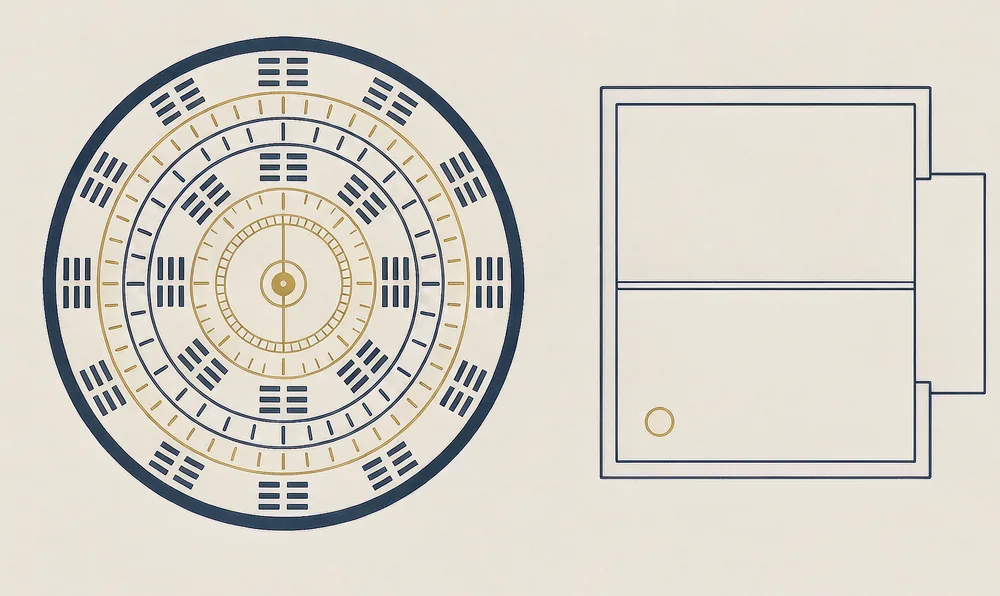
Feng shui means “wind-water”: a Chinese design discipline that reads how a space directs attention, light, movement and air, and adjusts the space so that the important things support you instead of working against you. Its classical forms — Flying Stars, Eight Mansions, the form school — are compass-based systems tied to Chinese astrology. What most westerners practice is a streamlined cousin of that: the bagua map (nine zones of a home mapped to life themes), personal directions from your birth year, and a set of room-level habits that environmental psychology has independently come to agree with — unobstructed paths lower background stress, natural light and bed orientation affect sleep, and visual clutter genuinely taxes attention.
You do not need to adopt a theory of energy to get value from any of this. Treat each recommendation as a reversible, testable change to a room, and keep the ones that measurably help.
The three levels, in the order to learn them
Level 1 — you. Your Kua number gives eight personal directions: four to use, four to be careful with. The two that matter most are Tian Yi (point the crown of your head toward it in bed) and Sheng Qi (face it at your desk). This takes two minutes and no equipment.
Level 2 — your rooms. Entryway clear and well-lit (it sets the tone of the whole home), bed with a solid headboard and a view of the door, desk facing into the room rather than the wall corner, and nothing major blocking a window. These hold up whether or not you believe in qi.
Level 3 — your house. The bagua map and Flying Stars need a floor plan, the building’s construction year and real compass bearings. This is where professional practitioners earn their fee; our tools deliberately stop short of pretending a form field can do it.
Objects, stones and the honest middle ground
Crystals, plants and mirrors are the part of feng shui most written about and least agreed on. The defensible version: an object earns its place by what it does for the room and for you — a black tourmaline on the desk matters if touching it resets your focus; a plant matters because living things in sight lines measurably aid recovery and attention. We make no claims beyond that. If a stone, a wind chime or a piece of thunder-wood makes a corner of your home feel deliberate, that is already doing part of the job.
Sources
Grouped by weight — the primary texts the rules come from first, then how this site applies them. Only grade A and B sources are used to support a factual claim; nothing here rests on a secondary summary alone.
- Primary text — Zang Shu (葬書), inner chapters, attributed to Guo Pu, 4th century — the founding text of feng shui, and the source of the qi-flow vocabulary used here.
- Primary text — Book of Changes (周易), the trigram system that feng shui's directional compass is built on.
Feng shui — frequently asked
What is the easiest feng shui tool to start with?
The Kua number. It takes your birth year and gender and returns four personal directions — no floor plan, no compass, no renovation. Most practitioners treat it as the entry point for exactly that reason.
Do I need a compass for feng shui?
Classical schools use one, and serious house analysis still does. But the personal side — your Kua directions — only needs the eight points of a phone compass app to find north.
Does feng shui require believing in energy?
No. Many people use it as a layout framework — clear sightlines, deliberate furniture placement, a bedroom that signals rest — and treat the directional claims as suggestions worth testing rather than doctrine.
How is western feng shui different from classical Chinese feng shui?
Classical feng shui is compass-based and tied to Chinese astrology and landform study. Most western adaptations simplify to door-based maps and personal numbers, which makes the system usable without specialist training — at the cost of some depth.

